# Math in Clinical Pharmacology

# Math in Pharmacokinetics

# First-Order Elimination Kinetics

<p>For most drugs, the amount of drug eliminated from the body during any time interval is proportional to the total amount of drug present in the body. In pharmacokinetic terms, this is called first-order elimination and is described by the equation</p>
<div align="center">
  <img src="https://latex.codecogs.com/svg.image?\frac{dC}{dt}=-kC">
</div>
<br>
<p>Separating variables:</p>
<div align="center">
  <img src="https://latex.codecogs.com/svg.image?\frac{1}{C}dC=-kdt">
</div>
<br>
<p>Integrating from 0 to t, where the amount is C<sub>0</sub> to C:</p>
<div align="center">
  <img src="https://latex.codecogs.com/svg.image?\int_{C_{0}}^{C}\frac{1}{C}dC=\int_{0}^{t}-kdt">
</div>
<br>
<p>So that:</p>
<div align="center">
  <img src="https://latex.codecogs.com/svg.image?lnC|_{C_{0}}^{C}=-kt|_{0}^{t}">
</div>
<br>
<p>And:</p>
<div align="center">
  <img src="https://latex.codecogs.com/svg.image?ln\frac{C}{C_{0}}=-kt"> 
</div>
<br>
<p>Taking exponetial:</p>
<div align="center">
  <img src="https://latex.codecogs.com/svg.image?C=C_{0}e^{-kt}"> 
</div>
<br>
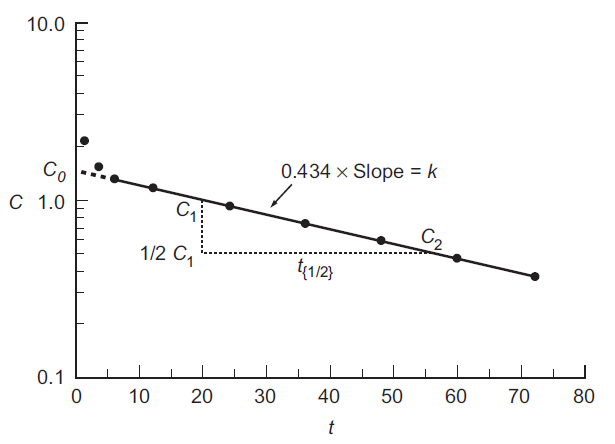
<p>It is particularly useful because it can be rearranged in the form of the equation for a straight line to give</p>
<div align="center">
  <img src="https://latex.codecogs.com/svg.image?lnC=lnC_{0}-kt"> 
</div>
<br>
<p>There is a real-world example:</p>
<div align="center">
  <img src="https://macrolib.com/uploads/images/gallery/2025-11/scaled-1680-/c0-back-extrapolation.png" 
       alt="C0 Back Extrapolation" 
       width="400" 
       height="300">  
</div>